When I loosened the tight vines for the first time in _Gibbon: Beyond the Trees_ and let the gibbon’s body draw a beautiful parabola in the air, the whistling wind in my ear suddenly turned into the roar of a chainsaw and the loud noise of falling trees. This Austrian independent game uses the purest sports simulation to bring players an immersive Southeast Asian rainforest ecological tragedy.
The game opens in a lush primitive jungle. I played the role of a wild white-cheeked gibbon, swinging freely between the canopy layers. The physics engine of the game perfectly restores the unique “arm jump action” of the gibbon — by accurately calculating the swing amplitude and the timing of release, it can achieve continuous movement without landing in the forest. But as the level advanced, discordant plaques began to appear in the emerald background: first, the red warning strip appeared sporadically, then the bare land with neat edges, and finally the whole forest became a neatly arranged rubber tree single crop forest. The narrative of the game has no text explanation, but every change of perspective tells the same story: the home is disappearing.
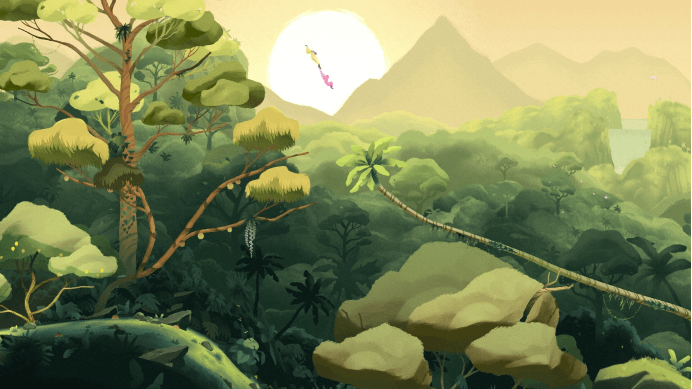
The most shocking design lies in the “sound landscape” of the game. In the chapter of the primitive rainforest, the background sound is a rich biological symphony: birdsong, insect hiss, and distant apes echo. But when the player entered the cut-down area, the sound of life suddenly disappeared, leaving only the monotonous wind and the faint sound of mechanical work. At the “Oil Palm Plantation” level, the gibbon I controlled was forced to run on the ground, and the clumsy gait contrasted cruelly with the elegance of the forest before. At this time, the game will suddenly insert a “memory flashback” — a few seconds ago, it was still the smooth swinging perspective of the tree crown layer, reminding the player and the ape: the former home was not like this.
As the journey progresses, the game reveals the complex chain behind the destruction of the rainforest. In the chapter of “Poaching Camp”, I need to avoid patrols to rescue young apes locked in cages; in the “River Pollution” paragraph, the once drinkable stream becomes a colored liquid with chemical odors; and the “Forest Fire” level uses a spreading red background and scorching sound effects to create a suffocating A sense of urgency. However, the game does not stop at simple environmental protection preaching, but shows the integrity of the ecosystem through the perspective of gibbons: when an ancient tree is cut down, it not only means the disappearance of a house, but also the breakage of the vine bridge, the death of fruit food, and the permanent change of the whole path of action.
The climax of the game takes place in the “Rescue Operation” chapter. Players are no longer just escaping, but need to take the initiative to lead a group of apes through human settlements to find the last protected area. At this time, the game mechanism has changed subtly: swinging is no longer just for speed and smoothness, but also needs to consider the ability of young and old individuals in the group, and sometimes even deliberately slow down or choose a safer route. This shift in responsibility from “surviving alone” to “group survival” makes the game experience sublimated from physical sports pleasure to emotional life resonance.
At dusk after clearing the level, I checked the link of the real rainforest protection organization attached to the game. The most valuable achievement of _Gibbon: Beyond the Trees_ is that it does not let players play heroes to “save” the rainforest, but allows players to become the rainforest itself and experience its vulnerability, tenacity and helplessness in the human age. This work proves that the best environmental education is not to accumulate data, but to make people really lose their home in the virtual world — even if it’s just for an hour.
If you also want to experience an ecological narrative that has no words but directly hits the soul, this work will give you the most silent and loudest warning. When the last rainforest disappears at the end of the swinging field of vision, you will understand that the distance between us and gibbons may be just between one release and the next grasp, and the air is rapidly shortening.