When I first witnessed the explosion of the sun in _Outer Wilds_, the huge red nebula swallowed up the entire galaxy, but when I found myself waking up by the campfire 22 minutes later, I realized that it was not just a time loop game. This is a cosmic archaeological site, and I am the only archaeologist with a shovel.
At the beginning of the game, I was like a headless fly. Driving a simple spaceship collided between the Gemini Star and the Broken Sky Star, either being torn apart by a black hole or swallowed up by a giant water dragon roll. Until the fifth cycle, I found the first projection left by the Nomais at the core of the Ember Star. Those glowing alien characters tell how an ancient race built orbital cannons in the galaxy, and their fate is closely linked to the supernova that is about to explode.
The most shocking discovery comes from the underwater city of the deep superstar. When I went through the layers of coral tunnels and activated the holographic projection in the central archives of the city, the history of the whole Nomai civilization unfolded like a picture scroll. Instead of extinction, they uploaded consciousness to the quantum tree. The most ironic thing is that it is the solar station they built to continue civilization that caused the supernova explosion.
The most exquisite design of the game lies in its “knowledge is progress” system. There is no equipment upgrade in my spaceship, only a continuous enrichment of navigation logs. What every death brings back is not resources, but a new understanding of the universe. I remember that in the thirteenth cycle, I finally cracked the law of the quantum moon — it only appeared in the shadow of a specific planet. When I successfully landed in the floating palace and found the last refuge of the Norwegians, I was so excited that my palms were covered with sweat.
As the exploration deepens, the hidden veins of the galaxy gradually become clear. The core of the black hole furnace hides the secret of time and space distortion, the underground of the wood furnace star is buried with a failed migration plan, and even the trajectory of each comet implies some cosmic law. What keeps me awake at night is the discovery on the quantum satellite — where the rocks will change shape according to the observer, and this quantum characteristic is the key to solving the final puzzle.
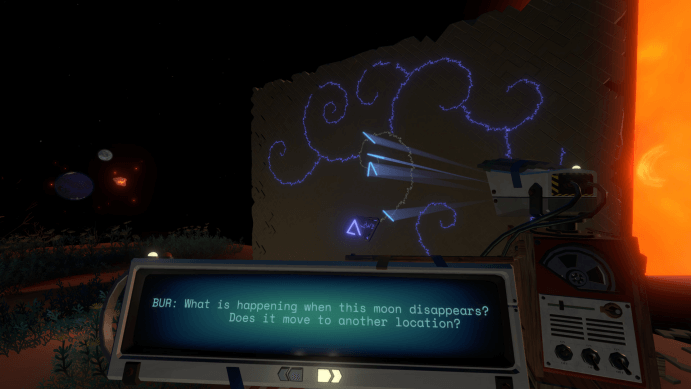
When I gathered all the clues in the twentieth cycle and finally understood the truth of the universe, the choice of the quantum tree made me fall into meditation. Is it to restart the universe that is about to be destroyed, or to join the Norwegians as a new observer? There is no right or wrong in this choice, only the ultimate question of the meaning of life.
Late at night after customs clearance, I went to the balcony to look up at the starry sky. The belt of Orion flickered in the night sky, and suddenly felt that there might be some civilization in the cycle of time behind those stars. The greatest thing about this game is that it makes me regain my curiosity about the universe — the kind of throbbing when I first saw the moon through a telescope in my childhood.
If you also want to experience the romance of reading a universe in 22 minutes, _Outer Wilds_ will give you the most shocking answer. It won’t give you equipment and level, but it will give you the whole starry sky as a reward. After all, when our life is only a moment compared with the universe, what can be left behind may be more important than how long we live.